
Blog / Understanding Torticollis in Children
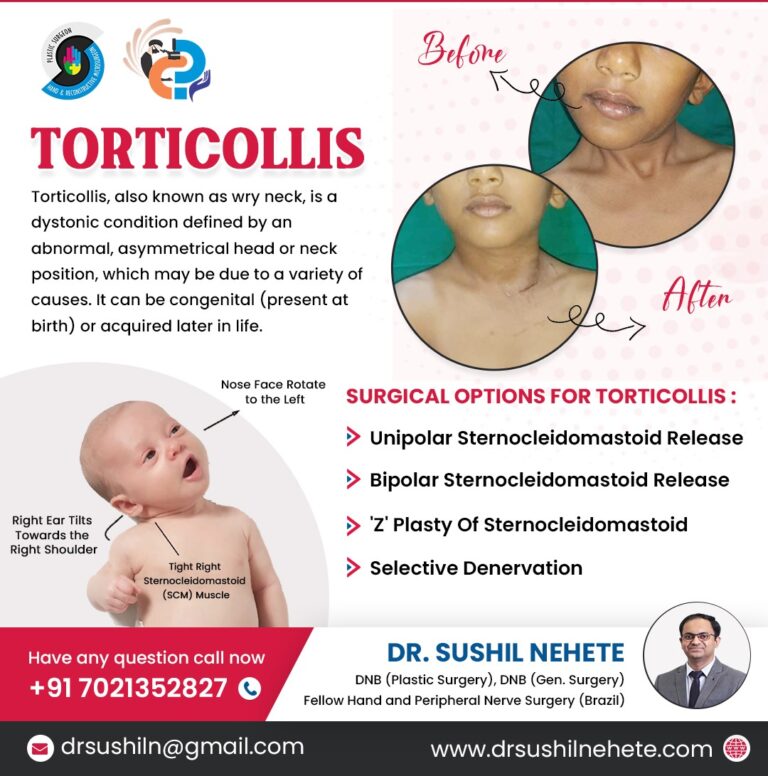
Torticollis, also known as wry neck, is a condition where a baby’s head tilts to one side while the chin rotates to the opposite side. Although this condition can be concerning for parents, timely diagnosis and appropriate treatment can help most children recover completely without long-term complications.
Torticollis can affect a baby’s neck movement, posture, and facial symmetry. Early intervention with physical therapy or surgery when needed helps restore normal movement and development.
Modern treatment approaches focus on improving neck mobility, correcting muscle tightness, and preventing long-term deformities.
Torticollis occurs when the neck muscles, particularly the sternocleidomastoid (SCM) muscle, become tight or shortened. This limits the baby’s ability to move the head freely and causes a persistent head tilt.
The condition may be present at birth (congenital) or may develop later due to infections, injuries, or spinal problems. Early evaluation helps determine the cause and best treatment approach.
This is the most common form of torticollis and is usually caused by tightening or shortening of the SCM muscle due to positioning in the womb or birth-related trauma.
This type develops after birth and may occur due to infections, neck muscle injuries, inflammation, or spinal abnormalities.
The baby consistently tilts the head to one side while the chin points toward the opposite side.
The child may have difficulty turning the head fully in one direction.
One side of the face may appear flatter because of persistent muscle tightness.
A small lump may sometimes be felt within the tightened SCM muscle.
Physical therapy and stretching exercises are the primary treatments for torticollis. However, surgery may be recommended in severe or persistent cases where conservative treatment does not provide sufficient improvement.
Surgical treatment helps release the tight neck muscles, improve head positioning, and restore normal neck movement.
The most common surgery involves releasing the sternocleidomastoid muscle from one or both of its bony attachments through a small neck incision.
In some cases, the shortened SCM muscle is lengthened using a specialized surgical technique called Z-plasty.
Overactive neck muscles may be selectively denervated to improve muscle balance and neck posture.
If surrounding tissues have become tight or rigid, they may also be released during surgery.
Rarely, additional neck muscles contributing to the deformity may require surgical correction.
The decision for surgery is made individually based on the severity of the condition, degree of neck stiffness, facial asymmetry, and response to physical therapy.
The child’s age, overall health, and expected benefits of surgery are carefully evaluated before planning treatment.
Torticollis surgery is generally performed as a daycare procedure with a relatively short recovery period. After surgery, the child may need to wear a cervical collar for neck support.
Physical therapy remains an essential part of recovery and helps maintain improved neck mobility while preventing recurrence of muscle tightness.
With early diagnosis and proper treatment, most children with torticollis recover completely within a few months and achieve normal neck movement and posture.


